 cskh@atld.vn
 0917267397


NIOSH Lifting Equation Calculator : Workplace injuries caused by poor lifting techniques and ergonomically unsafe tasks remain among the most common occupational health and safety concerns
The NIOSH Lifting Equation & Ergonomics Calculators provide employers and workers with powerful tools to assess and control these risks.
By integrating these calculators into workplace safety programs—or directly onto your OHSE website—organizations can prevent injuries, reduce lost time, and improve employee well-being.
Understanding the NIOSH Lifting Equation
The Revised NIOSH Lifting Equation (RNLE) is a widely recognized tool developed by the National Institute for Occupational Safety and Health (NIOSH) to determine safe lifting limits for workers.
It calculates a Recommended Weight Limit (RWL) for a given lifting task and a Lifting Index (LI) to measure risk.
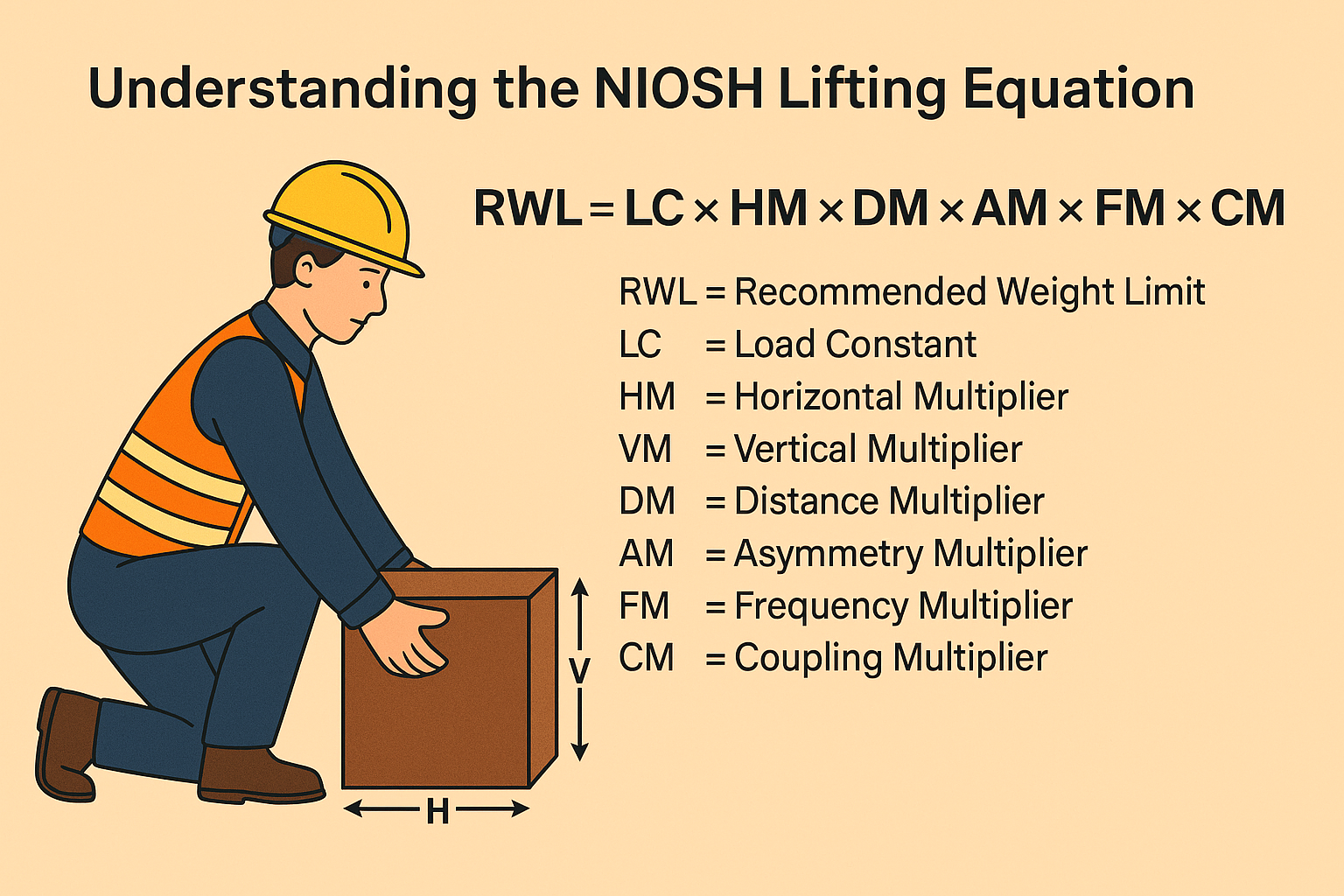
The Formula

Where:
- LC (Load Constant): 23 kg (51 lb) baseline safe load.
- HM (Horizontal Multiplier): Distance of the hands from the body.
- VM (Vertical Multiplier): Starting height of the lift.
- DM (Distance Multiplier): Vertical distance the load is moved.
- AM (Asymmetry Multiplier): Degree of twisting during the lift.
- FM (Frequency Multiplier): Number of lifts per minute, task duration.
- CM (Coupling Multiplier): Quality of hand-to-object grip.
Lifting Index (LI)

- LI ≤ 1.0 → Safe for most workers.
- LI > 1.0 → Higher risk; task redesign recommended.
- LI ≥ 3.0 → Serious hazard; unacceptable risk.
Key Benefits of NIOSH & Ergonomics Calculators
| Benefit | Impact on Workplace Safety |
|---|---|
| Objective Risk Measurement | Eliminates guesswork in lifting safety |
| Injury Prevention | Reduces risk of back injuries and MSDs |
| Productivity Boost | Workers perform tasks more efficiently with less strain |
| Compliance | Aligns with OSHA ergonomics guidance and international OHSE standards |
| Employee Confidence | Shows commitment to health and safety, improving morale |
NIOSH Lifting Equation Calculator
Example: Applying the NIOSH Lifting Equation
Scenario:
A warehouse worker lifts a 15 kg box from the floor (30 cm high) to a shelf at 120 cm. The box is 40 cm away from the worker’s body, and the task is repeated 3 times per minute for 1 hour.
Input values:
- Load Weight = 15 kg
- Horizontal Distance (H) = 40 cm
- Vertical Start (V) = 30 cm
- Distance (D) = 90 cm (120 – 30)
- Asymmetry Angle (A) = 0° (no twisting)
- Frequency = 3 lifts/min
- Coupling = Good (value = 1.0)
Result:
- RWL ≈ 12.5 kg
- LI = 15 / 12.5 = 1.2
Interpretation: The task slightly exceeds safe lifting recommendations. Employers should reduce the weight, improve lifting technique, or redesign the task to reduce risk
- Số CNĐKKD: 3702404496 cấp ngày 13/10/2015
Nơi cấp: Sở KH-ĐT tỉnh Bình Dương - Địa chỉ: 502 Đỗ Xuân Hợp, P. Phước Bình
TP. Thủ Đức, TP. Hồ Chí Minh
- Điều khoản & Quy chế hoạt động
- Chính sách bảo mật
- Hướng dẫn sử dụng
- Người đại diện: Nguyễn Thị Mỹ
- Số điện thoại: 0917267397
- Email: cskh@atld.vn
